Advancing Service AI Delivery and Operational Efficiency
Advancement in AI infrastructure competition is shifting from GPU capacity to the delivery of reliable token services at predictable cost. A Token Factory integrates GPU resources, model deployment, inference optimization, and resource management to convert compute capacity into AI production services. Its business value depends on meeting AI application requirements for performance, availability, and cost efficiency.
As AI model portfolios, applications, and multi-tenant clients expand, optimization must address the full-service lifecycle, from deployment and token generation to ongoing operations. This requires a unified software platform that coordinates resource allocation, inference execution, and service management across the AI infrastructure, to improve operational efficiency and sustain predictable service performance.
1. From GPU Capacity to Token Services: Redefining AI Compute Operations.
Traditional GPU rental providers supply contracted compute capacity, leaving model deployment and execution to customers. As neocloud providers expand into model APIs and token services, they take responsibility for production inference performance and availability. This requires coordinated model deployment, capacity allocation, latency and throughput management, tenant isolation, and token metering. Token services create new revenue opportunities, but sustainable margins depend on operational efficiency as well as pricing. Providers must improve GPU utilization, match capacity to variable demand, and reduce costs per token delivery, while maintaining consistent service performance.
Enterprises face a similar transition as more departments and applications share AI infrastructure. Although they typically do not sell tokens, they must provide reliable, continuously available model services, while support rapid model deployment and switching, secure access control, service quality, and cost management. Agent workloads add demand variability through repeated inference, tool calls, and long contexts. Token throughput and latency can vary substantially across the same GPU pool depending on model characteristics, concurrency, and request patterns. Enterprises therefore need to extend GPU resource management into coordinated model service operations.
Neocloud providers and enterprises share a common operational goal: maximize token delivery within service-level objectives (SLOs) while controlling costs. GPU utilization and peak throughput (tokens/s) alone do not capture this balance. Larger batches can improve throughput but may increase time to first token (TTFT) beyond interactive service targets, while maintaining idle GPU reserves raises the cost of handling demand spikes. Operators must therefore evaluate token throughput achieved within SLOs against the compute capacity and operating expenditure required to sustain it.
2. Coordinating Software Across the Entire Token Factory Stack
Already established tools address individual functions across the AI infrastructure stack: GPU schedulers allocate compute resources, inference engines optimize execution, and API gateways and monitoring systems provide access control and observability. A Token Factory, however, must sustain continuously available model services, requiring coordinated workflows and tasks across these multiple components throughout the service lifecycle.
Deploying a new model requires coordinated configuration of model versions, GPU resources, inference instances, API endpoints, tenant permissions, and quotas. These dependencies must remain synchronized as tenants are added, models are updated, and capacity changes. As model portfolios and applications expand, operators must manage the configurations, data, and workflows that connect individual tools into a consistent operational environment.
Inference optimization requires visibility across the entire stack. Elevated TTFT may result from request queueing, prefill load, KV-cache misses, or insufficient GPU capacity. Cache-aware routing can reduce redundant computation but may increase queueing delays. Prefill–decode disaggregation allows resources to be allocated according to each phase’s requirements, but its effectiveness depends on capacity balancing and cache-transfer overhead. Adjusting request routing, inference parameters, or instance capacity therefore requires coordinated decisions informed by complete service-level objectives, runtime conditions, and GPU availability.
Token Factory operations also require integrated service governance and cost management. Request and usage data must be associated with specific models, tenants, and compute resources to enable cost attribution and capacity planning. Shared services require tenant isolation, quotas, and access controls. Assessing long-term service efficiency, security, and economic sustainability therefore requires a combined view of consumption, resource utilization, costs, and security policy enforcement.
The solution is a unified orchestration and operations layer that can coordinate specialized components while preserving their independent evolution. This layer manages models, tenants, services, and compute resources collectively, linking service objectives to inference conditions and resource consumption to guide adjustments across the stack. By standardizing integration and operational workflows, it reduces repetitive engineering and manual coordination, enabling continuous efficiency improvements within defined service-quality constraints. Specialized components can still evolve independently; the platform provides the orchestration, management, and operational coordination between them.
3. MotusAI: Unifying Service and Operations Across the Token Factory Lifecycle
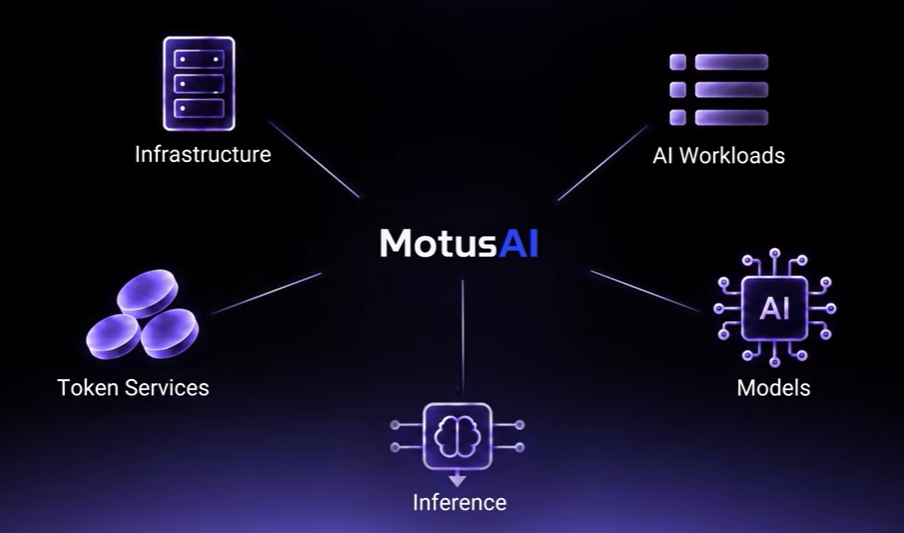
MotusAI integrates GPU resource management, model deployment, inference optimization, and token service governance into a unified operational framework. Designed for Token Factories, it coordinates these functions throughout the token service lifecycle, from deployment and delivery to ongoing management and optimization:
Service launch. MotusAI coordinates GPU pooling and scheduling, model deployment, API publishing, and tenant and quota configuration to bring models into service quickly. A consistent workflow aligns compute resources, model configurations, and access policies when introducing or replacing models, reducing repetitive deployment and integration work across systems. For neocloud providers and enterprise IT teams managing frequent model releases, this approach can shorten the time required to launch token services.
Inference execution. MotusAI integrates with inference engines such as vLLM and SGLang and supports prefill–decode disaggregation, dynamic KV-cache management, and dynamic batching to improve effective token throughput under real-world workloads. By correlating TTFT, token throughput, and GPU utilization, it informs inference instance configuration, resource allocation, and elastic scaling. Its value extends beyond individual optimization techniques by coordinating execution and resource decisions with service-level performance requirements. Efficiency gains must be validated under representative workloads by measuring SLO attainment, effective token throughput, and resource consumption.
Ongoing operations. MotusAI combines a unified API, multi-tenant isolation, access controls, token metering, and quota management to enforce usage boundaries and security policies across customers and departments. Linking usage data to model deployments and GPU resource records enables resource tracking by model and tenant, supporting cost allocation, capacity planning, and service pricing. Assessing overall profitability also requires accounting for hardware amortization, energy consumption, operations and maintenance costs.
These three stages are closely interconnected. Deployment of cross-related models, tenants, and compute resources; runtime metrics guide inference tuning and runtime capacity adjustments; and operational data collection, informs subsequent deployments, capacity planning, and cost optimization. MotusAI coordinates these activities to integrate service delivery, performance management, and governance into a sustainable operating framework for Token Factories.
Conclusion:
Token Factory competitiveness depends on advances in GPU and inference technologies alongside coordinated resource management, inference execution, and service operations. As AI infrastructure shifts from capacity provision to token service delivery, software platforms must support optimization across the full-service lifecycle. MotusAI supports this transition by connecting GPU management, inference optimization, and service governance, helping enterprises and neocloud providers sustain reliable token services and improve operational efficiency.



 Contact Us